by Leslie Moldenauer | | Essential Oils
You will be able to find a plethora of articles on the internet regarding essential oils, consequently, there are many myths surrounding them. There are many opinions regarding essential oil safety as well. Some have even become fanatical about the advice (which does not feel authentic to me), shaming others online as a means to teach them. Anyone that has followed me over the years knows that safety is in fact very important to me, but I will never shame you for the choices you have made in the past, ones you are making today, or if you choose not to take the advice you have read today. My job is to help guide you, and you choose to take on whatever resonates with you. This is how we learn. 3 Common Yet Risky Essential Oil Mistakes…..
The widespread marketing of two popular brands of essential oils has introduced many people to these powerful tools for health which is a real blessing. With it comes a few concerns. The first being the unsafe recommendations for use that is seen on blogs, Pinterest, as well as Facebook pages. Essential oils are not to be used carelessly, and misuse can lead to injury. The second is sustainability. So many are of the vein of ‘buy all of the oils’, and that can be really problematic for the future of our precious oils.
Just as you would (or should) exercise caution and research when using pharmaceuticals, you should practice the same careful research when using essential oils. Essential oils are profoundly powerful, which makes them capable of powerful healing, but also injury when used improperly. Overuse and misuse can and does lead to injury.
1. Diluting Essential Oils
Essential oils are very concentrated extracts, much more concentrated than the plant material that it is derived from. Since they are so concentrated, they need to be diluted before they are safe to apply to the skin.
When used undiluted or what some call “neat” there are two risks involved:
1-Irritation which is a direct result of contact with a material and is localized. Healing occurs once the material is removed. Removal is best with a carrier oil (almond, jojoba, etc.) or milk. Follow up with warm soapy water, then add more carrier oil if needed. Healing may not occur immediately, but you should see and feel improvement after proper removal.
2-Sensitization which is a systemic response involving the immune system. According to Dorene Petersen, president of the American College of Healthcare Sciences (ACHS):
“Sensitization occurs once the offending substance has penetrated the skin, been picked up by proteins in the skin, and mediated by the IgE response that produces histamine and other irritants” [1].
This is an allergic reaction. Some oils are more likely than others to elicit this sensitization response, such as lemongrass and cinnamon bark….but it can happen even with oils that some consider gentler oils such as lavender and peppermint. Once this immune system response is triggered, that may mean you can never use that oil again. Never! Compare this to a nut allergy. Not worth the risk!
Please do not subscribe to the “detoxing” explanation where skin irritation is concerned, this is simply not true. If you get a rash or a burn from putting something on your skin is it because it is irritating your skin. Unfortunately, the detox reaction is still being shared as a viable explanation for a rash, and innocent people are being injured. Sometimes by applying more essential oils to the irritated area. Please hear me when I say, skin irritation that can result from essential oils is NOT a detox reaction at all. There is good news in all of this though, and that is when you properly dilute your essential oils, the risk of any irritation is greatly reduced.
Check here for a detailed explanation on this topic from my friend and colleague Liz Fulcher, owner of the Aromatic Wisdom Institute.
2. Internal Use
Essential oils are not water soluble. Oil and water do not mix/blend. They need a dispersant before adding to your bath water (carrier oil); Epsom salts alone is not enough.
Please do not add essential oils to a glass of water and drink it.
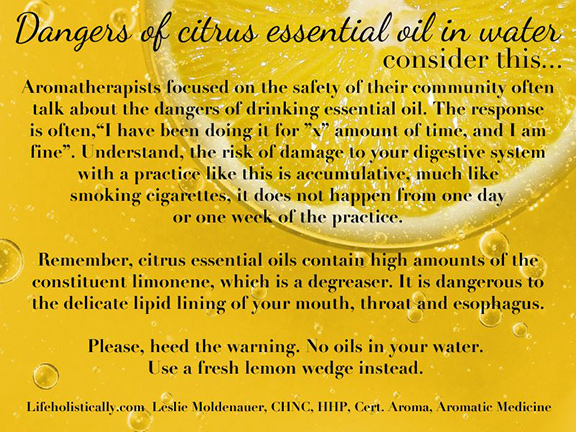
When you add a drop of oil to a glass of water it doesn’t mix with the water. The risks are not worth the practice. Oral dosing may interfere with medication or aggravate other medical conditions. Please refer to the 2014 book, Essential Oil Safety 2e by Robert Tisserand and Robert Young to learn which essential oils carry the most risk internally when taking daily medication.
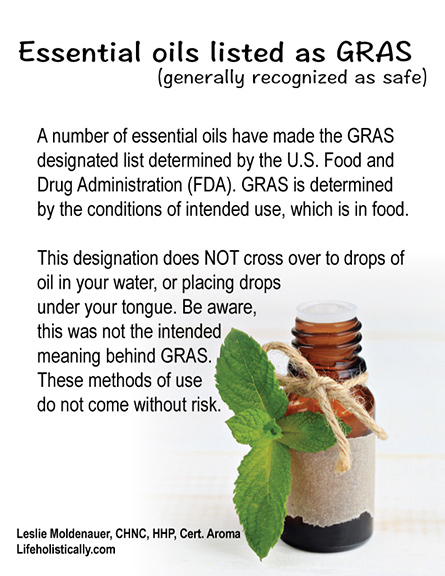
You may hear something like “our oils are pure therapeutic grade and are safe for internal use” or “certain oils are GRAS” (generally recognized as safe for consumption), but this applies to consuming in food (food additives); not in water. Follow the link here for an informative article by my friend and colleague, The English Aromatherapist about what GRAS really means.
Essential oils can be safe for internal use under certain circumstances when under the care of a professional; someone who has been trained, ultimately much more than the basic 200 hour foundation training, and has to understand how these oils react inside the body, if it is necessary for your condition, and most of all if it is safe and indicated for you and your situation (medication, medical conditions, allergies, etc.). Look for someone such as myself who has been trained in aromatic medicine. Not all aromatherapists have this level of training.
More on Internal Use…
Internal use is not meant to be an everyday practice. It is not to lose weight, ease indigestion, or to be used as a preventative measure to maintain health. That is where healthy eating, exercise, sleep, vitamins, and minerals come into play when you are deficient. Essential oils have no “nutritional value”; another myth. Read more on these topics here and here.
Just to reiterate so that my stance is clear, I am NOT against internal use of essential oils. I am against the methods that are recommended online that are risky, such as oils in water, directly under the tongue, and in a capsule without a carrier oil. Not safe.
3. Over Diffusing of Essential Oils
If a little bit works, more is not necessary. This applies with topical use, and diffusion as well.
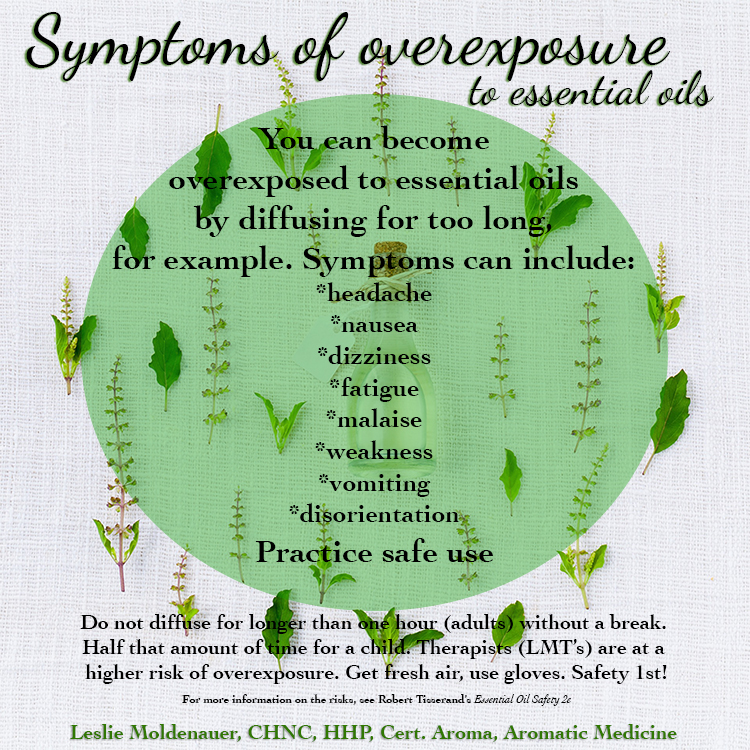
Essential oil diffusers disperse the essential oil into the air in tiny droplets. Robert Tisserand recommends diffusing times of 30-60 minutes, or 30 minutes on and 60 minutes off [2]. If you are diffusing in a small room, make sure to have proper ventilation. I think Tisserand’s recommendations may be generous when looking at small children, therefore, I will go one step further to say that if you are diffusing for a small child, 15-20 minutes on and 60 minutes off will be more than sufficient for them. If you decide to diffuse for a baby, six months or older, 10 minutes will likely be just enough.
When we inhale too much of a good thing, we can have adverse effects. Tisserand stated in his book, Essential Oil Safety 2e, “prolonged inhalation (more than about 30 minutes) of concentrated essential oil vapors (e.g., steam inhalation or direct from a bottle) can lead to headaches, vertigo, nausea and lethargy” [3].
You can also experience an overall feeling of being unwell marked by malaise or disorientation, or even heartburn. I get heartburn from diffusing cinnamon (Cinnamomum zeylanicum).
The good news is that when we follow basic safety advice, any risk of utilizing essential oils is greatly reduced. If you have any questions about essential oil safety, please reach out to me @ Lifeholistically@gmail.com.
References
[1] American College of Healthcare Sciences, (2012) Aroma 101
[2] [3] Tisserand, R., Young, R. (2014) Essential Oil Safety (2nd Ed)

Like so many practices in life, I encourage you to become educated on the proper use of essential oils. When using them, please do so cautiously, understanding that there is often misinformation on the internet. You can be assured that I support only educated and proven resources. While essential oils should not be feared they should be respected and used properly to ensure the safety of the individuals using them.
Please note that I am not a medical practitioner. The content of this website is provided for general informational purposes only and is not intended as, nor should it be considered a substitute for, professional medical advice. Do not use the information on this website for diagnosing or treating any medical or health condition. If you have or suspect you have a medical problem, promptly contact your professional healthcare provider. By using this website, you assume full responsibility and liability for your own actions.
BEFORE YOU GO! Remember to sign up for my FREE Facebook group! Hang out with me and THOUSANDS of other Essential Oil lovers looking to learn, click on to join Real Essential Oil Education Group!
Check out my FREE offer below!
by Leslie Moldenauer | | Essential Oils
What is an adverse reaction to an essential oil? Would you know what to do if you or your child had an adverse reaction to an essential oil or oil blend? Do you know what an adverse reaction looks like? I will be covering a few of those here in hopes to make you more aware of what that might look like, and what to do if it happens. When we use essential oils, safety has to be the first thing we keep in mind.
First and foremost, this article is not written to scare or instill fear, but to make you more knowledgeable. I want to empower you to use them properly and know what to look for in the rare case there is a reaction. It is important to note, if you are following basic safety instructions, the likelihood of an adverse reaction is greatly reduced.
Skin Reactions
The first thing to look out for when using essential oils topically is skin reactions.
-Skin irritation, which is a direct result of contact with the skin and is localized to where the oil was applied. Once the material is removed, healing occurs. Removal is best done with a carrier oil such as almond, jojoba, or milk. Healing may not occur immediately, but you should see improvement after proper removal.
-Skin sensitization is a more serious reaction that is systemic (affecting the entire body or organism), involving the immune system called sensitization.
According to Dorene Petersen, president of the American College of Healthcare Sciences (ACHS):
“Sensitization occurs once the offending substance has penetrated the skin, been picked up by proteins in the skin, and mediated by the IgE response that produces histamine and other irritants” [1].
This is an allergic reaction that begins at the site of application but quickly spreads to the whole body. If the immune system response is activated, you likely will not be able to use the oil, or constituent in the oil again (the constituent can occur in multiple oils).
If this happens to you please seek medical attention immediately. Save the bottle of oils for the medical staff, to help them to understand what they are dealing with. (Poison Control (800) 222-1222…24 hours a day)
–Phototoxic reactions can occur from a specific list of oils. This can occur when certain essential oil constituents on the skin react when exposed to the sun (ultraviolet light). Tanning beds also need to be avoided. This can result in general redness and burning of the skin, changes in melanin of the skin, and there is even potential for a more serious reaction such as chemical burns. These oils can be used on the skin, but utilize caution by not going out into the sun for 12-24 hours after exposure. If you follow this simple safety precaution, you will never have to deal with this type of reaction.
**It is important to note that this applies to the area of skin where the oil was applied, not your body as a whole.
Here is a list of oils that should be used topically with caution, and their maximum use levels according to the International Fragrance Association (IFRA) standards [2]:
Angelica Root (Angelica archangelica) 0.8%
Bergamot (Citrus bergamia) 0.4%
Bitter Orange (Cold/Expeller Pressed) (Citrus aurantium) 1.25%
Cumin (Cuminum cyminum) 0.4%
Grapefruit (expressed) (Citrus paradisi) 4.0%
Lemon (Cold/Expeller Pressed) (Citrus limon) 2.0%
Lime (Cold/Expeller Pressed) (Citrus aurantifolia) 0.7%
Mandarin Leaf (Citrus reticulate) 0.17%
Rue (Ruta graveolens) 0.15%
Taget (Tagetes minuta) 0.01%
*If you have a phototoxic reaction such as a chemical burn, seek out the care of a medical professional to reduce permanent effects.
Diffusing Essential Oils
Essential oil diffusers disperse the essential oil into the air in tiny droplets. Robert Tisserand recommends diffusing times of 30-60 minutes, or 30 minutes on and 60 minutes off [3]. If you are diffusing in a small room, make sure to have proper ventilation. I think Tisserand’s recommendations may be generous when looking at small children, therefore, I will go one step further to say that if you are diffusing for a small child, 15-20 minutes on and 60 minutes off will be more than sufficient for them. If you decide to diffuse for a baby, six months or older, 10 minutes will likely be just enough.
In order to explain possible reasons for the recommended times, let’s talk a little bit about our sense of smell, or our olfactory system.
Dorene Petersen of the American College of Healthcare Sciences (ACHS) states that:
“Our sense of smell goes through five stages, those are: detect, transmit, perceive, analyze, and store. These stages cycle incredibly fast. The reception area of our olfactory system is called the olfactory epithelium. The olfactory epithelium is the size of a small postage stamp in each nostril, and is packed with an impressive 40 million sensory neurons, capable of detecting .0000000013 of an ounce of a scent in a single breath of air” [4].
Our olfactory system is incredibly efficient, obtaining the therapeutic benefits of these amazing oils happens quickly. To receive maximum benefit and not waste your precious oils, follow the diffusing times recommended above.
When we inhale too much of a good thing, we can have adverse effects. Tisserand stated in his book, Essential Oil Safety 2e, “prolonged inhalation (more than about 30 minutes) of concentrated essential oil vapors (e.g., steam inhalation or direct from a bottle) can lead to headaches, vertigo, nausea and lethargy” [5].
You can also experience an overall feeling of being unwell marked by malaise or disorientation, or even heartburn. I get heartburn from diffusing cinnamon (Cinnamomum zeylanicum).
Concentrated essential oil vapors are considered direct inhalation. What is considered direct inhalation and what is considered passive inhalation?
Direct Inhalation
Steam inhalation (steam tent or steam bowl)
Handheld nebulizer
Directly from the bottle
Inhalers (aromastick)
On hands, cupping the nose
On a cotton ball or other material right up to the face
I recommend avoiding these methods of use under the age of five.
Indirect/Passive Inhalation
Diffusers (atomizers, ultrasonics, nebulizers, fan diffusers, aromastone)
You can greatly reduce risk by practicing safe diffusion times, matching up the right diffuser for your space, and being mindful of adverse reactions. Remember, when you have babies, toddlers, etc., they are not likely going to be able to tell you if they are having symptoms of overuse. They are counting on you to make the best choices you can.
*For more information on safe diffusing, please refer to Essential Oil Safety 2e by Robert Tisserand and Rodney Young.
Internal Use
At times online and in social media, internal use is recommended quite casually without much respect for their true power. In my opinion, if you are not trained in the internal use of oils (Aromatic Medicine) or are being helped by someone who is, this is a risky thing to do. Why would I say this? Often times the methods that are being shared are not at all the way that they should be used. Let me explain…
The liver is not equipped to handle this amount of aromatics. You may have heard in certain circles that essential oils are pure and this is perfectly safe. Essential oils are still chemicals. The liver’s job is to recognize foreign substances such as these and remove them as quickly as possible. A good analogy here is water in a glass. Begin pouring water in, once the glass has hit maximum capacity the water overflows. The liver is no different.
Oral dosing can interfere with medication or aggravate other medical conditions. You may hear something like “our oils are pure therapeutic grade and are safe for internal use” or “certain oils are GRAS” (generally recognized as safe for consumption), but this applies to consuming in food (food additives), not in water.
Internal usage does have its time and place, but you MUST know what you are doing…or at the very least, consult with someone who has been properly trained.
Here is another great reference to learn more about internal use.
Interference with Medications
Some oils are contraindicated for use when taking certain medications. These oils can be problematic for those taking diabetes medication, heart medication, cancer medication, and medications via patches just to name a few.
If you are sharing the benefits of oils to others, are you aware of the specific contraindications? If so, are you asking your neighbor or friend what kinds of medications they are taking? The majority (not all) of these warnings are more of a concern when taking the oils internally, but if you are unaware, this can really be a concern.
*For more information on medications that can interfere with essential oil use, please refer to Essential Oil Safety 2e by Robert Tisserand and Rodney Young.
Closing
As I mentioned above, when you follow proper safety measures, you are much less likely to experience adverse affect. If you are unsure of something, please feel free to reach out to me anytime at Lifeholistically@gmail.com
References
[1] Petersen, D. (2012) Aroma 101-sensitization. American College of Healthcare Sciences (p 50)
[2] IFRA standards. Retrieved from http://www.ifraorg.org/en-us/standards-library/s/phototoxicity#.V9VaSpMrJn4,
[4] Peterson, D. (2012) Aroma 101. American College of Healthcare Sciences
[3] [5] Tisserand, R., Young, R. (2014) Essential Oil Safety (2nd Ed)
BEFORE YOU GO! Remember to sign up for my FREE Facebook group! Hang out with me and THOUSANDS of other Essential Oil lovers looking to learn, click on to join Real Essential Oil Education Group!
Check out my FREE offer below!
Please note that I am not a medical practitioner. The content of this website is provided for general informational purposes only and is not intended as, nor should it be considered a substitute for, professional medical advice. Do not use the information on this website for diagnosing or treating any medical or health condition. If you have or suspect you have a medical problem, promptly contact your professional healthcare provider. By using this website, you assume full responsibility and liability for your own actions.
Essential Oils-Uncovering Fact From Fiction
Why Is It That Essential Oils Don’t Always Work